
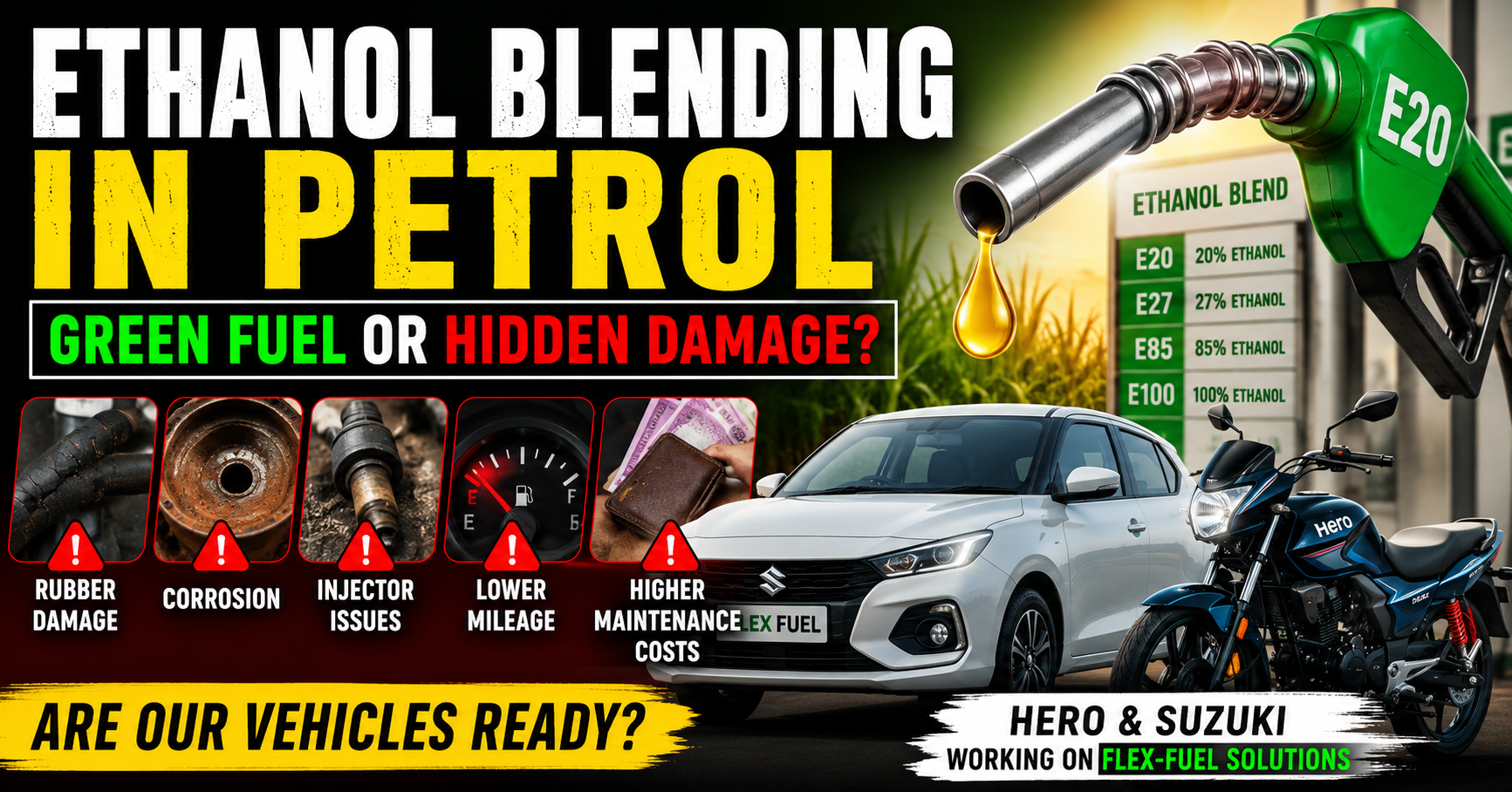
If you’ve visited a petrol pump recently, you may have noticed stickers mentioning E20 fuel. The government has been aggressively promoting ethanol blending in petrol, and many people believe it’s a major step towards reducing pollution and India’s dependence on imported crude oil.
But as vehicle owners, there’s one important question we need to ask:
Are our vehicles actually ready for it?
The answer is more complicated than most headlines suggest.
This article is not against ethanol, nor is it blindly supporting it. Instead, let’s look at the reality of ethanol-blended fuels, their benefits, their drawbacks, and what they could mean for millions of vehicles already running on Indian roads.
What is Ethanol Blending?
Ethanol is an alcohol-based fuel usually produced from sugarcane, corn, and agricultural waste.
When ethanol is mixed with petrol, the fuel is identified by the percentage of ethanol present:
- E10 = 10% Ethanol + 90% Petrol
- E20 = 20% Ethanol + 80% Petrol
- E27 = 27% Ethanol + 73% Petrol
- E85 = 85% Ethanol + 15% Petrol
- E100 = 100% Ethanol
India has already moved towards E20 fuel in many regions and has announced ambitious plans for higher ethanol usage in the future.
On paper, it sounds excellent.
Less crude oil imports.
Support for farmers.
Reduced emissions.
Improved energy security.
But what happens when this fuel enters vehicles that were never designed for it?
Why the Government is Promoting Ethanol
India imports a significant portion of its crude oil requirements.
Every year, billions of dollars leave the country to pay for imported fuel.
By blending ethanol into petrol, the government aims to:
- Reduce oil imports
- Support sugarcane farmers
- Increase energy independence
- Reduce carbon emissions
- Promote renewable fuels
These goals are understandable and beneficial for the country’s economy.
The problem isn’t the intention.
The problem is the transition.
The Reality: Most Vehicles on Indian Roads Were Not Designed for High Ethanol Blends
This is where concerns begin.
Millions of motorcycles, scooters, hatchbacks, sedans, SUVs, and commercial vehicles currently running in India were originally designed for lower ethanol content.
Many of them were never tested for E20, let alone E27, E85, or E100.
Yet ethanol blending is increasing much faster than the replacement cycle of vehicles.
A vehicle purchased 5 or 10 years ago cannot magically become ethanol compatible overnight.
How Ethanol Can Affect Your Vehicle
1. Reduced Fuel Efficiency
One of the biggest complaints among vehicle owners is mileage.
Ethanol contains less energy than petrol.
This means:
- More fuel may be required to produce the same power.
- Fuel economy can decrease.
- Frequent refueling may become necessary.
In simple words, your fuel tank may empty faster.
2. Rubber and Plastic Component Damage
Older vehicles are especially vulnerable.
Ethanol can be more aggressive toward:
- Fuel hoses
- Rubber seals
- O-rings
- Plastic fuel components
Over time, these parts can:
- Swell
- Harden
- Crack
- Leak
What begins as a minor issue can eventually become a costly repair.
3. Corrosion Inside the Fuel System
Ethanol attracts moisture from the atmosphere.
This characteristic is known as hygroscopic behavior.
When moisture accumulates inside the fuel system, it can contribute to:
- Corrosion in fuel tanks
- Rust formation
- Fuel injector issues
- Fuel pump wear
The long-term impact becomes more visible as vehicles age.
4. Increased Maintenance Costs
As ethanol content rises, manufacturers may need to redesign:
- Fuel pumps
- Injectors
- Fuel lines
- Engine calibration
Owners of older vehicles may face:
- More frequent maintenance
- Replacement of fuel system components
- Unexpected repair expenses
5. Cold Start Challenges
Countries using very high ethanol blends have often reported cold-start difficulties.
While this is less severe in most parts of India, it remains a challenge for E85 and E100 applications.
This is one reason why specialized flex-fuel systems are required.
Are E27, E85, and E100 Practical Right Now?
In my opinion, not for the majority of Indian vehicles currently on the road.
The technology exists.
The fuel exists.
But the vehicle fleet does not.
For E85 and E100 to work effectively, manufacturers must design engines specifically for them.
Without proper engineering, owners could face:
- Reduced reliability
- Fuel system damage
- Lower performance
- Higher maintenance costs
The fuel itself isn’t the enemy.
Using it in the wrong vehicle is the problem.
What Are Flex-Fuel Vehicles?
Flex-fuel vehicles are designed to automatically adjust to different ethanol percentages.
These vehicles can safely operate on:
- Petrol
- E20
- E27
- E85
- Various mixtures in between
They use:
- Ethanol-resistant fuel lines
- Specialized injectors
- Advanced engine management systems
- Modified combustion settings
This is arguably the correct way to introduce higher ethanol blends.
First build compatible vehicles.
Then expand fuel availability.
Suzuki and Hero Are Working on Flex-Fuel Technology
The good news is that manufacturers have recognized the challenge.
Companies such as Hero and Suzuki are reportedly working on flex-fuel motorcycles and vehicles capable of handling higher ethanol concentrations safely.
This is a positive development.
Instead of forcing conventional engines to adapt, manufacturers are redesigning vehicles for the fuel they will actually use.
That is how long-term reliability can be maintained.
The Biggest Concern: Existing Vehicle Owners
This is where the debate becomes serious.
Millions of Indians purchased vehicles under one set of fuel expectations.
Now fuel composition is changing.
The average rider or car owner is asking:
“Will my vehicle last as long as promised?”
“Will maintenance costs increase?”
“Will my mileage drop?”
These are legitimate concerns.
If ethanol blending continues to increase, consumers deserve:
- Clear information
- Compatibility guidelines
- Manufacturer support
- Affordable retrofit solutions where possible
The burden should not fall entirely on vehicle owners.
Is Ethanol Blending Good or Bad?
The honest answer is:
It depends on how it’s implemented.
The Good Side
✔ Reduces crude oil imports
✔ Supports farmers
✔ Lowers fossil fuel dependence
✔ Potentially reduces emissions
✔ Improves energy security
The Bad Side
✘ Lower fuel efficiency
✘ Potential damage to older fuel systems
✘ Corrosion concerns
✘ Higher maintenance costs
✘ Existing vehicles may not be fully compatible
✘ Consumer confusion
Final Thoughts
Ethanol blending is not inherently bad.
In fact, it may play an important role in India’s future energy strategy.
However, fuel policy and vehicle technology must evolve together.
Introducing higher ethanol blends before a large percentage of vehicles are designed to handle them creates understandable concerns among consumers.
Flex-fuel technology from manufacturers like Hero and Suzuki could be the bridge that makes this transition smoother.
Until then, vehicle owners should stay informed, follow manufacturer recommendations, and pay close attention to fuel-system maintenance.
The goal should not simply be greener fuel.
The goal should be greener fuel without sacrificing reliability, affordability, and the trust of millions of vehicle owners who depend on their vehicles every single day.
At the end of the day, a fuel is only successful when both the environment and the consumer benefit from it.
