
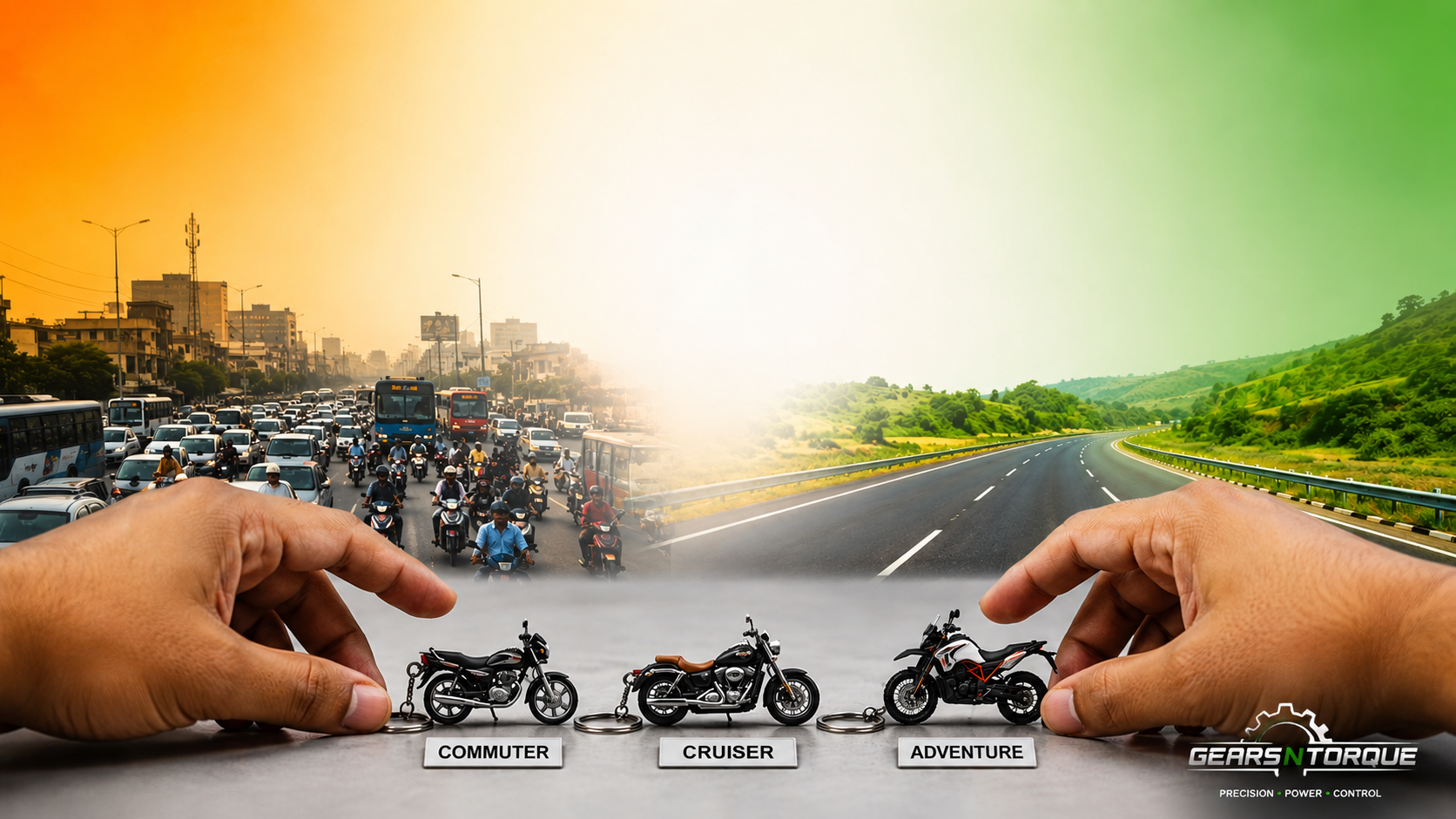
Look around you at any Indian traffic signal. What do you see? A sea of two-wheelers navigating through gaps that cars can only dream of. In a country where the two-wheeler is not just a vehicle but a way of life, choosing the right bike isn’t a casual decision—it’s almost a rite of passage.
As India recorded total bicycle sales of 10.67 million units in FY 2023-24 and the two-wheeler market continues to boom, the options available to you are truly overwhelming . But here’s the thing: the bike that makes your neighbor’s eyes light up might be completely wrong for you .
The Indian roads are unique—they demand a bike that can handle everything from smooth highways to pothole-ridden city streets, from heavy traffic to sudden rain showers. This guide is designed specifically for you, the Indian buyer, to navigate this complex decision with confidence.
Part 1: The Indian Road Reality Check
Before we talk about CCs or mileage, let’s be honest about where you’ll actually be riding. Unlike the pristine roads of Europe or the wide American highways, Indian roads present a unique set of challenges.
The Three-Roads Reality
The City Commute: Stop-and-go traffic, aggressive auto-rickshaws, sudden pedestrian crossings, and roads that can transform from perfect to potholed in 500 meters.
The Highway Cruise: High speeds, long distances, and the constant need to overtake trucks and buses. Here, you need power and stability.
The Village/Off-Road Stretch: This is where roads become suggestions rather than paths. Gravel, mud, broken asphalt—your bike needs to handle it all.
The hidden truth: No single bike excels at all three. Your choice must prioritize the roads you’ll actually ride. A sportbike might look cool, but on Bangalore’s traffic-clogged roads, you’ll be nursing a sore back within a week .
Part 2: Know Your Bike Types (Indian Context)
COMMUTER BIKES (100cc – 125cc)
What they are: The workhorses of Indian roads. Lightweight, fuel-efficient, and built for daily grind.
Best for:
- Daily city commuting
- First-time buyers
- Budget-conscious riders
- Those who prioritize mileage over performance
Popular Models:
- Hero Splendor Plus (Under ₹1 lakh) – The undisputed king of comfort on Indian roads
- Honda Activa (if you’re considering scooters)
- Bajaj Platina
The Good:
- 65-80 kmpl mileage
- Low maintenance costs (₹800-1,500 per service)
- Easy to maneuver in traffic
- Parts available everywhere
The Bad:
- Struggles on highways
- Limited power for overtaking
- Not suitable for long-distance touring
Price range: ₹60,000 – ₹1,20,000
Indian reality check: For 90% of your riding, a commuter bike is all you need. Don’t be fooled by the “more CC is better” myth .
ADVENTURE/DUAL-SPORT BIKES (150cc – 450cc)
What they are: Tall, with long-travel suspension, designed to handle both city traffic and rough terrain.
Best for:
- Mixed city and highway riding
- Frequent weekend getaways
- Pothole-heavy roads
- Taller riders
Popular Models:
- Hero XPulse 210 (₹1.62 lakh) – “The bike will take care of everything without bothering you at all”
- Royal Enfield Himalayan 450 (Under ₹3 lakh) – “Magical” is how reviewers describe it
- KTM 390 Adventure
The Good:
- Suspension that absorbs Indian roads effortlessly
- High riding position gives better visibility
- Can handle almost any terrain
- Good for both city and highway
The Bad:
- Tall seat height can be challenging for shorter riders
- Higher maintenance costs
- Less fuel-efficient than commuters
Price range: ₹1.5 lakh – ₹4 lakh
Indian reality check: Adventure bikes are increasingly popular because they genuinely make riding on bad roads comfortable. The Hero XPulse series, in particular, is praised for making even the worst roads feel manageable .
CRUISER BIKES (350cc – 650cc)
What they are: Low-slung, relaxed riding position, classic styling. Think Royal Enfield.
Best for:
- Highway touring
- A relaxed, laid-back riding style
- Those who want a “statement” bike
- Riders with back issues (upright posture)
Popular Models:
- Royal Enfield Classic 350
- Royal Enfield Bullet 350
- Jawa 42
The Good:
- Comfortable for long distances
- Commanding road presence
- Good low-end torque for city traffic
- Decent pillion comfort
The Bad:
- Heavy (makes parking and maneuvering harder)
- Lower mileage (30-40 kmpl)
- Not nimble in traffic
Price range: ₹1.5 lakh – ₹3.5 lakh
Indian reality check: Royal Enfield continues to dominate this segment because they genuinely understand what Indian riders want—a bike that’s comfortable for both rider and pillion, especially for daily commutes with family members .
SPORTS/NAKED BIKES (200cc – 400cc)
What they are: Performance-focused bikes with more power, better handling, and aggressive styling.
Best for:
- Young riders who want excitement
- Weekend enthusiasts
- Those who enjoy spirited riding
Popular Models:
- Bajaj Pulsar NS200 (₹92,000) – “Built for short commutes and quick weekend runs”
- TVS Apache RTR 200 4V (₹1.41 lakh)
- Triumph Speed 400
The Good:
- Excellent performance
- Great handling
- Modern features
The Bad:
- Lower mileage (28-35 kmpl)
- Stiffer suspension (less comfortable on bad roads)
- Pillion comfort often compromised
Price range: ₹90,000 – ₹3.5 lakh
Indian reality check: The Triumph Speed 400 has gotten rave reviews as a “killer bike in this segment” for Indian roads, with users praising its smooth ride, premium build quality, and surprisingly good value at its price point .
ELECTRIC BIKES/SCOOTERS
What they are: Battery-powered, eco-friendly, and increasingly popular.
Best for:
- Daily commutes under 80 km
- Environmentally conscious riders
- Those who want low running costs
- Urban residents with charging access
Popular Models:
- Ola Electric
- Ather 450X
- Revolt RV400
The Good:
- Low running cost
- Instant torque (great for city traffic)
- Environmentally friendly
- Tax benefits and subsidies
The Bad:
- Range anxiety
- Charging infrastructure still limited
- Higher upfront cost
- Battery replacement costs
Price range: ₹80,000 – ₹2 lakh
Indian reality check: Electric two-wheelers are “reshaping the Indian bicycle market,” attracting a broader consumer segment including older adults, delivery personnel, and urban commuters .
Part 3: The Budget Breakdown (Indian Reality)
When you look at a bike’s price tag, remember the on-road price is significantly higher.
The On-Road Price Reality
A bike priced at ₹80,000 ex-showroom easily becomes ₹95,000-1,00,000 on-road after registration, road tax, and insurance .
For a ₹1.5 lakh bike, expect: ₹1.7-1.8 lakh on-road.
For a ₹3 lakh bike, expect: ₹3.4-3.5 lakh on-road.
Maintenance Costs (Annual)
Insurance costs: ₹3,000-6,000 for comprehensive coverage on a new bike
EMI Planning
Your monthly EMI should stay within 40-50% of your monthly take-home pay. On a ₹70,000 loan at 14% over 24 months, you’ll pay back approximately ₹80,000-82,000 .
Hidden costs: Helmet (₹1,000-5,000), bike cover (₹500-2,000), accessories, and regular fuel costs.
Part 4: The Indian Road Test — What Actually Matters Here
Suspension: Your Back Will Thank You
For Indian roads, suspension isn’t a luxury—it’s a necessity. The 2025 reports consistently emphasize that comfort is the single most important factor when selecting a bike for Indian conditions .
Adventure bikes like the Hero XPulse 210 and Royal Enfield Himalayan 450 are praised for their suspension, which absorbs everything Indian roads throw at them. Even commuter bikes like the Hero Splendor Plus have surprisingly good suspension, capable of being “hammered through bad roads” without bottoming out .
The suspension rule: If you can, test ride on bad roads. Showrooms usually have smooth roads nearby—ask to take it to a pothole section. That’s where you’ll know.
Pillion Comfort (Mandatory in India)
In a country where family rides are common, pillion comfort is often as important as rider comfort. Many Indian buyers prioritize bikes with:
The Royal Enfield Classic 350 and Bullet 350 are good choices if you often carry a pillion . Alternatively, options like the TVS Apache RTR 200 4V, Bajaj Pulsar N250, and Suzuki Gixxer 250 offer sporty looks while maintaining comfort .
Important: Test ride with your regular pillion. Their comfort matters as much as yours.
Safety Features (Non-Negotiable)
ABS (Anti-lock Braking System): Law requires it on bikes above 125cc. ABS prevents wheels from locking up during hard braking—critical on wet or broken roads .
CBS (Combined Braking System): Mandatory on 125cc and below. One brake activates both in a set ratio .
Disc brakes: Front disc brakes perform better in rain than drum brakes .
LED headlights: Most Indian roads aren’t well-lit. LED lights give you more reaction time at night .
Side-stand engine cut-off: Prevents riding with the stand down—sounds minor until it prevents a fall .
Part 5: The Mileage vs. Performance Dilemma
This is where many buyers get stuck. Here’s the simple breakdown:
100cc bikes: 65-80 kmpl
125cc commuters: 55-65 kmpl
150cc-200cc: 40-50 kmpl
200cc-400cc: 28-38 kmpl
For someone doing 30 km daily, the difference between a 100cc and a 200cc bike is nearly double the monthly fuel cost. If 90% of your riding is city commuting, chasing high CC is not a practical decision—it’s an expensive one .
The honest truth: The Triumph Speed 400 may be a “hidden beast” with low-end torque that makes city traffic “not so miserable,” but it delivers just 27-30 kmpl . The Hero Splendor Plus, on the other hand, is the “Lord Splendor” for a reason—it just works .
Part 6: How to Choose the Right Bike for YOUR Indian Reality
Here’s the decision framework, Indian-style:
Ask Yourself These Questions:
1. Where will you ride 90% of the time?
- City streets only → Commuter bike (100cc-125cc)
- Mixed city + highway → Adventure bike or 150cc+
- Long highways + touring → Cruiser or 350cc+
- Rough roads/off-road → Adventure bike
2. Who will ride with you?
- Solo rider → Sporty options open up
- Regular pillion (family) → Prioritize pillion comfort
- First-time rider → Start with commuter bike
3. What’s your actual budget (not ex-showroom)?
- Under ₹1 lakh on-road → Commuter bikes only
- ₹1-2 lakh on-road → Good commuters, entry-level sports, adventure
- ₹2-3 lakh on-road → Royal Enfield, entry-level premium
- ₹3 lakh+ → Premium sports, adventure, cruisers
4. What’s your real mileage need?
- Daily 20 km → Any bike works
- Daily 40 km → Commuter or high-efficiency bike
- Daily 60 km+ → Electric or high-efficiency commuter
5. How tall are you?
- Shorter riders → Royal Enfield, low-seat commuters
- Taller riders → Adventure bikes (higher seat, better visibility)
Part 7: Popular Recommendations Based on Budget
Under ₹1 Lakh (On-Road)
Hero Splendor Plus – The ultimate Indian commuter. Comfortable, reliable, and handles bad roads surprisingly well .
₹1-2 Lakh (On-Road)
Hero XPulse 210 – The best adventure bike for this budget. Comfortable, capable, and praised for its suspension .
TVS Apache RTR 200 4V – Sporty but practical, with pillion comfort .
₹2-3 Lakh (On-Road)
Royal Enfield Himalayan 450 – “Magical” suspension, handles everything, comfortable for both rider and pillion .
Royal Enfield Classic 350 – Classic cruiser with excellent pillion comfort .
₹3 Lakh+ (On-Road)
Triumph Speed 400 – “A true all-rounder… engaging and manageable in the city, as well as fun and stable for the highways” .
KTM 390 Adventure – More sporty suspension, fully adjustable, handles off-roading well .
Part 8: The Test Ride — Your Final Decision
Before signing anything:
The Indian Test Ride Checklist:
City Simulation:
- Start from a stop in traffic
- Navigate through narrow gaps
- Check the turning radius
Bad Road Test (most important!):
- Find a pothole section
- Note how the suspension feels
- Check if your pillion complains
Highway Feel:
- Get to 60-80 kmph if possible
- Check for vibrations
- Assess overtaking capability
Pillion Check (non-negotiable):
- Bring your regular pillion
- Check seat comfort, grab rails
- See if they can easily mount/dismount
Before You Buy, also:
- Check the manufacturer’s service network (essential in India)
- Look up real-world mileage online (claimed mileage is always optimistic)
- Read user reviews from actual Indian owners
- Check insurance costs for your model
- Compare on-road prices across dealers
Part 9: The Maintenance Reality (Indian Context)
Mass-market bikes:
- Service network everywhere
- Parts easily available
- Regular service affordable
- Trusted mechanics available
Premium bikes:
- Service centers only in major cities
- Parts may need ordering
- Higher service costs
- Specialized mechanics required
Indian reality check: If you’re in a tier-2 or tier-3 city, the service network is as important as the bike itself. A premium bike with the nearest service center a district away is a real problem when something breaks down .
Part 10: Resale Value (Don’t Ignore This)
If you plan to sell in 3-5 years:
High resale value brands:
- Hero
- Bajaj
- Royal Enfield
- Honda
Lower resale value brands:
- Premium niche brands
- Less popular models
A well-maintained commuter bike from a popular manufacturer can retain 55-70% of its original value after three years. A lesser-known brand can lose value much faster .
Final Word: The Indian Bike Decision
Here’s what it comes down to, simple and clear:
- City only, daily use, budget under ₹1.5 lakh → Commuter bike (Hero Splendor or similar)
- Mixed city + highway, comfort priority → Adventure bike (Hero XPulse or Himalayan)
- Long highways, touring, family rides → Cruiser (Royal Enfield Classic/Bullet)
- Performance focus, weekend enthusiast → Sports/Naked (Pulsar, Apache, Triumph)
- Daily short commutes, eco-friendly → Electric scooter
The right bike for India is the one that:
- Handles our broken roads comfortably
- Fits your actual budget (on-road price)
- Has a service network near you
- Comfortably accommodates your pillion
- Gives you enough mileage for your daily ride
Final advice: Test ride on bad roads. Check real-world mileage. Confirm the service network. And most importantly—get the bike that makes you want to ride.
Because in the end, the best bike for India is the one that gets you home, through traffic, through potholes, through rain, with a smile on your face.
